Kerið: The Crater That Collapsed Into a Lake
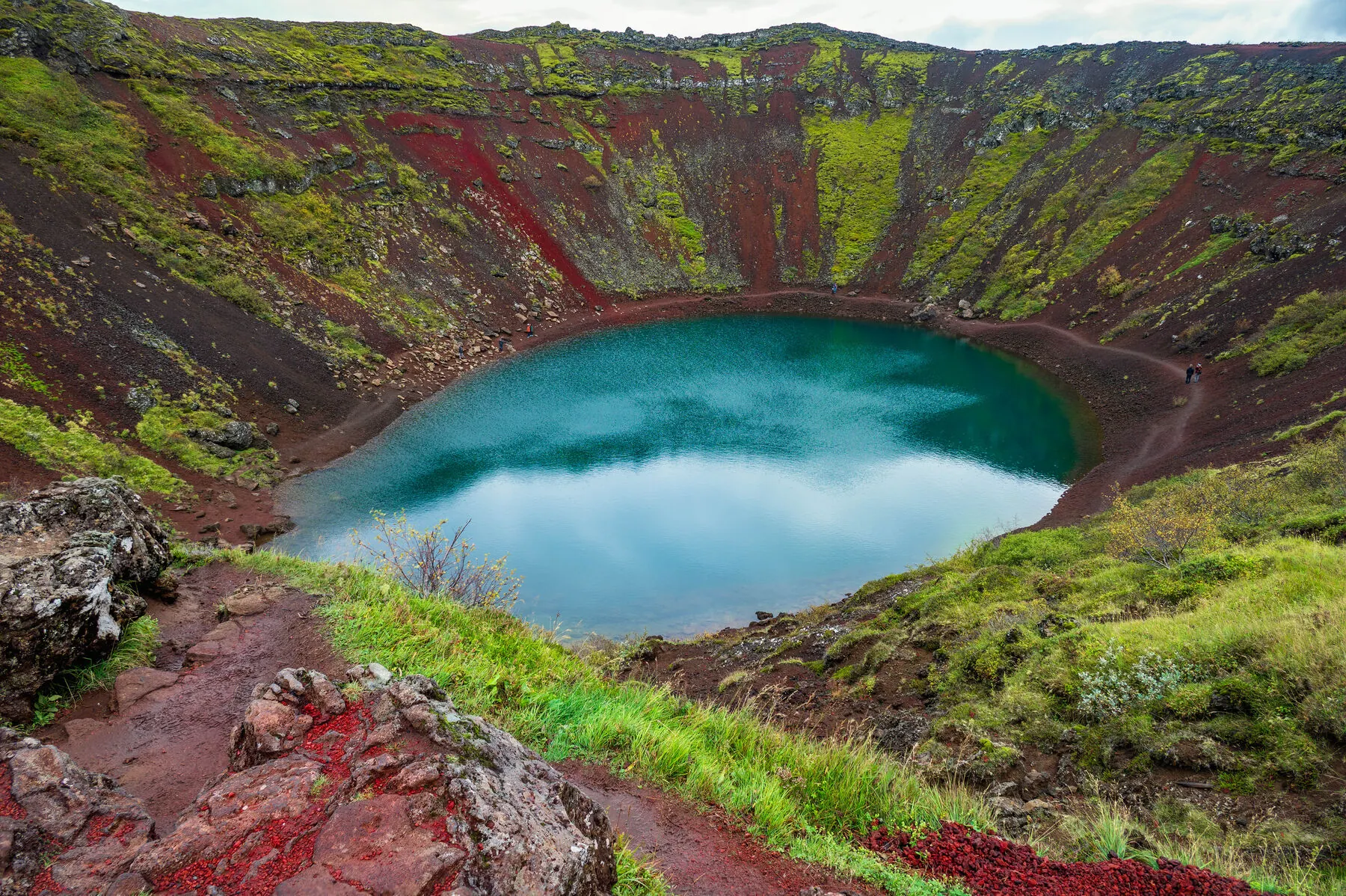
Most of Iceland's volcanic craters got their shape from an eruption blasting rock outward. Kerið got its shape from the opposite event — a volcano that emptied itself so thoroughly it caved in on its own empty chamber, leaving behind a bowl of deep red rock cradling a small, impossibly blue lake. It's one of the most photographed stops on the Golden Circle, and one of the youngest and strangest landmarks in it.
A Volcano That Fell Into Itself
Kerið formed roughly 3,000 years ago, during an eruption that behaved differently from most. Rather than building a cone by piling up ejected material, the volcano drained its magma chamber almost completely during the eruption. With the pressure gone and nothing left underground to support the weight above, the crater's floor simply collapsed down into the emptied chamber — the same basic mechanic as a soufflé sinking once the air inside escapes. What was left behind is a near-perfect oval bowl, about 270 metres long and 170 metres wide, dropping some 55 metres from the rim down to the water. Because the eruption was comparatively recent by geological standards, the crater hasn't had thousands of extra years of weather to soften its edges or fade its colour — which is a large part of why it still looks so sharp and so vivid today.
Why the Lake Looks Almost Unreal
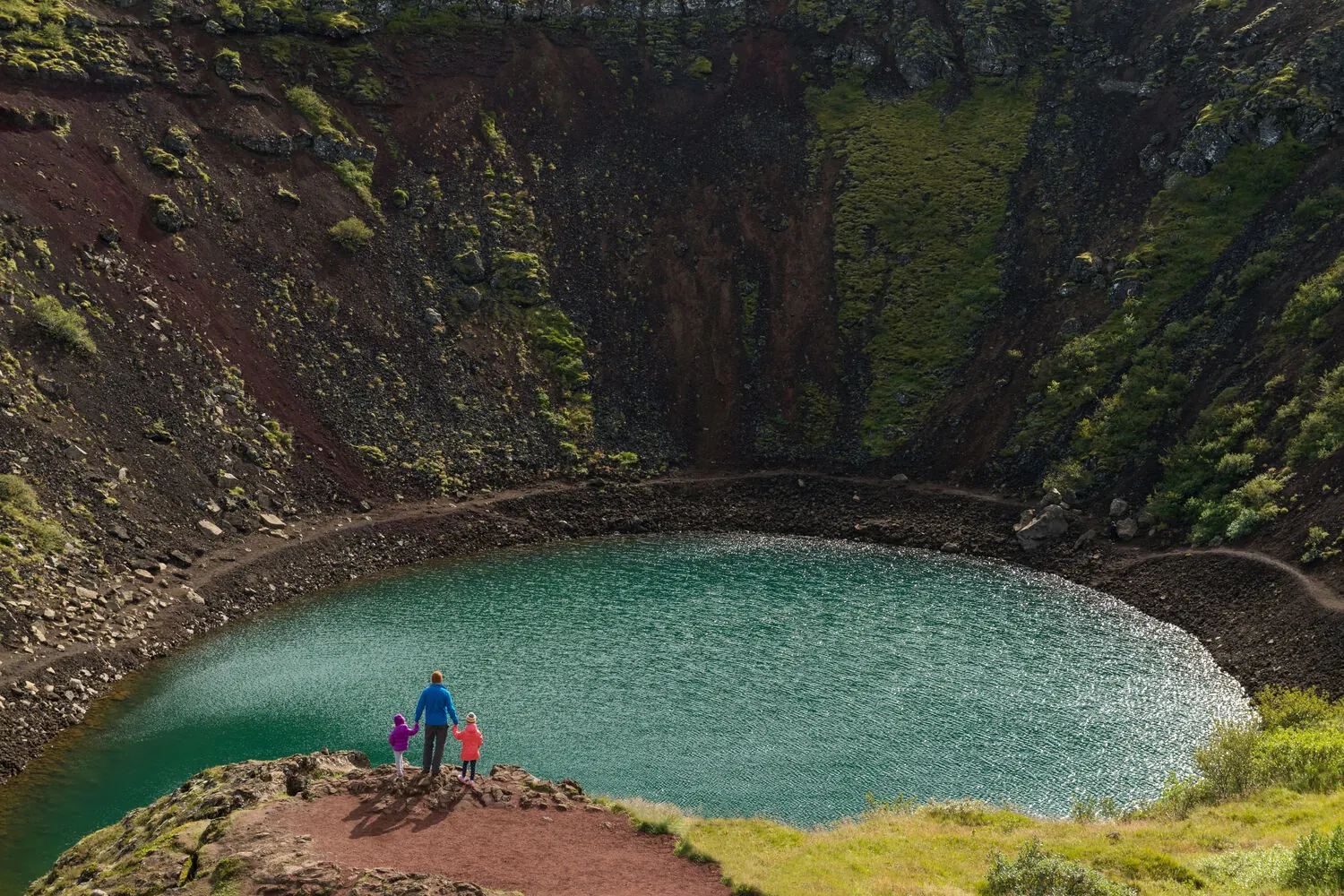
The colour contrast at Kerið is almost aggressive: rust-red and black volcanic rock, streaked here and there with green moss, wrapped around a lake that reads as a startling, mineral turquoise-blue. Part of that colour comes from the iron content in the surrounding rock, and part of it from the lake itself — minerals, algae and microorganisms adapted to this particular pocket of water all contribute to the shade. The lake itself is shallow, generally estimated at somewhere between 7 and 10 metres deep, fed primarily by groundwater rather than any visible stream, which keeps its level fairly steady across the seasons.
The Farmer's Treasure and the Bottomless Lake
Kerið has its own piece of local folklore, and unlike the crater's geology, it doesn't hold up to measurement quite as well. Legend has it that a wealthy farmer, fearing theft, hid his fortune somewhere in the crater's depths. On his deathbed, he revealed the treasure's exact location to his daughter alone, binding her to secrecy — she was permitted to retrieve it only if the family fell into genuine hard times. Whether anyone ever did is, appropriately, lost to history. A second, more persistent bit of local belief holds that the lake is bottomless, secretly connected to other bodies of water through underground passages. It isn't — surveys put its depth at a modest 7 to 10 metres — but it's an easy story to believe standing at the rim, looking down at water that colour.
A volcano young enough to still look freshly made, holding a lake that looks deeper than it is.
Small Facts Worth Knowing
- Kerið didn't erupt itself into a crater — it emptied its magma chamber, then collapsed inward, the same way a soufflé sinks once the air escapes.
- It's roughly 3,000 years old — young by volcanic standards, which is part of why its colours are still so vivid and its slopes so intact.
- The crater spans about 270 by 170 metres — and drops some 55 metres from rim to water.
- The lake itself is shallow— roughly 7 to 10 metres deep, despite local legend insisting it's bottomless.
- Its colour comes from more than the water — minerals, algae and microorganisms in the lake combine with iron-rich volcanic rock to produce the red-and-blue contrast.
- It's privately owned — by a single Icelandic family, unusual for a landmark this well-known, and a small entry fee goes toward its upkeep.
Before You Go
A path circles the entire rim, and a steeper trail drops down to the water's edge if you want the view looking up instead of down — both are short, but the descent is loose gravel in places, so proper footwear helps. Because Kerið is privately owned, there is a small entry fee that goes directly toward maintaining the paths, unlike most of Iceland's natural sites. Give it twenty to thirty minutes; it's a small stop, but rarely a quick one to walk away from.
Kerið Rounds Out Our Golden Circle
Our Golden Circle Tour closes the day at Kerið, with time to walk the rim before we head back to Reykjavík.
See the Golden Circle Tour →